
Thailand Vietnam Tourism: a 20-to-1 lost game
Every recurring complaint about Vietnam tourism — Tet gridlock, airport taxi scams, littered beaches, resorts stalled mid-negotiation — traces back to the same structural fact: there is no dedicated Ministry of Tourism to coordinate them. For property owners, operators, and travelers exposed to this market, that's not a footnote. It's a risk factor.
Vietnam's tourism sector has no ministry — and no amount of investment fixes that
Every recurring complaint about Vietnam tourism — Tet gridlock, airport taxi scams, littered beaches, resorts stalled mid-negotiation — traces back to the same structural fact: there is no dedicated Ministry of Tourism to coordinate them. For property owners, operators, and travelers exposed to this market, that's not a footnote. It's a risk factor.
Risk
Confirmed
No seat at the table
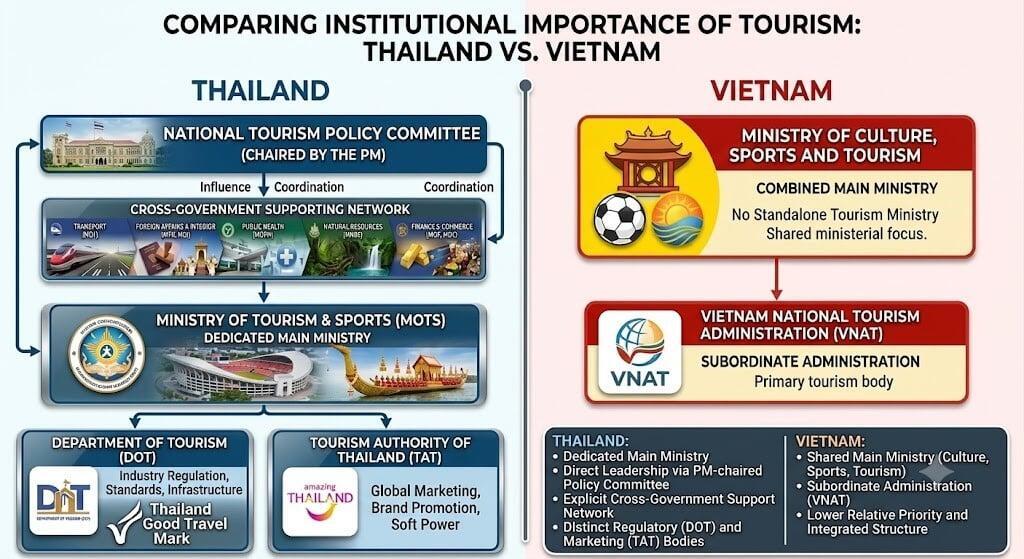
Vietnam manages tourism through the Vietnam National Tourism Administration (VNAT) — a subordinate administration buried inside the Ministry of Culture, Sports and Tourism, sharing budget and political weight across three unrelated mandates.
Compare that to Thailand, where the Ministry of Tourism and Sports is a standalone main ministry reporting into a National Tourism Policy Committee chaired directly by the Prime Minister — with a dedicated Department of Tourism for regulation and the Tourism Authority of Thailand for global marketing. In Thailand's model, tourism sits as a peer to Finance, Transport, and Foreign Affairs. In Vietnam's, it sits underneath a shared ministry with no independent standing.

Thailand's tourism governance runs top-down from a Prime Minister-chaired policy committee, giving the sector direct leverage over Transport, Foreign Affairs, Public Health, Natural Resources, and Finance.
For anyone with capital exposed to Vietnamese hospitality assets, this matters concretely: resort development sits under Construction, Agriculture and Environment — none of which report to VNAT, and none of which are obligated to prioritize a project's tourism value over their own review timelines.
Fighting a well-funded neighbor with a fraction of the tools
Thailand's tourism authority alone operates with roughly USD 173 million a year in dedicated funding. VNAT shares an estimated USD 8–10 million, carved out of a parent ministry budget of around USD 142 million that also has to stretch across culture and sports nationwide.
A denser, more populous market with more infrastructure to coordinate is working with a fraction of the resourcing its regional benchmark enjoys — and that gap shows up directly in how slowly issues get resolved on the ground.
Building or holding hospitality assets in Vietnam?
Resort and property development here clears Construction, Agriculture, and Environment reviews with no single authority coordinating the timeline. Cover the gap.
What it takes to clear a single tourism decision
Something as simple as a national campaign or a resort opening has to clear an inter-ministerial maze, with no single body empowered to move it through:
- Visa policy — touches four separate ministries before a rule can change.
- Airlines & airports — Ministry of Transport, including the incoming Long Thanh and Gia Binh airports.
- Resort & infrastructure — Construction, Agriculture and Environment.
- Traveler safety & entry — Public Security and Foreign Affairs.
- Tax incentives — Ministry of Finance.
- Heritage, festivals, museums — Ministry of Culture.
- Health protocols — Ministry of Health, activated only during outbreaks.
None of these report to VNAT. VNAT can request coordination — it cannot compel it.

Thailand: a dedicated main ministry with direct PM-level leadership. Vietnam: tourism sharing a combined ministry, with VNAT as a subordinate administration lower in the priority chain.
Why the pattern doesn't get fixed by press coverage
As a one-party state, the Ministries of Public Security and Foreign Affairs are built to protect national stability first. Tourism's international image is a secondary concern for them. When enforcement makes headlines, the intended audience is domestic — a signal of order — even when the side effect is a negative story abroad. Structural complaints tend to surface quietly, if at all, because dwelling on service failures risks contradicting the national image the government wants to project.
On the ground, this fragmentation is what travelers and operators keep running into: repeated failed attempts by international resort operators to establish a foothold; Tet-holiday transport gridlock that returns every year with no single owner of the fix; littering enforcement that barely functions because environmental fines require a different chain than the traffic fines police already know how to issue; and Phu Quoc — a visa-free zone split between two private developers, with no authority coordinating roads or waste treatment for the island as a whole.
Traveling to or through Vietnam?
Airport taxi scams, transport gridlock during Tet, and inconsistent visa enforcement are recurring — not rare. Get covered before you land.
The fix isn't a bigger budget. It's a bigger mandate.
Every issue in this file shares one root cause: no ministry in Vietnam holds the budget, political weight, and cross-government authority to make other ministries act in tourism's interest.
Thailand's model works because its Prime Minister-chaired committee gives tourism standing equal to Finance, Transport, and Foreign Affairs when priorities collide. Until Vietnam consolidates tourism into an equivalent ministry, improvements will keep arriving piecemeal — a new decree here, a stimulus visa policy there — always downstream of ministries with other priorities. That governance gap, more than any single policy misstep, is a structural reason Vietnam continues to record one of the lowest tourist return rates in Asia.
Get the next Partner Risk briefing
Structural risk analysis on Southeast Asia's tourism, property, and hospitality markets — straight to your inbox.
— paste your Zoho Forms iframe embed code here —